Showing posts with label Television. Show all posts

Saturday, 21 January 2012

The Problem Finale

I try not to be too much of a fangirl on this blog (or ever. To me fangirls are terrifying squealy creatures) but these past three weeks I've not really been able to help myself. All because of some lanky detective with a bad attitude and a silly hat...

WARNING: SUPERMASSIVE SPOILER ALERT

I don't care what anybody else says, I thought that the final episode of Sherlock, series two, was a masterful piece of television.  As usual the main focus has been on the two main actors, but credit where credit's due; the story was solid, cunning, and well written (especially considering that it wasn't written by the show's co-creators, who have penned all the strongest episodes so far), the direction and shot composition was fantastic, the production was great, and it hadn't really hit me what the team had done until yesterday - all six episodes are an hour and a half long each.  They've made us six movies.  The film industry has always had more pomp and glitter surrounding it than British television, so to see a show that can hold that amount of interest for that amount of time when most movies can't even make a decent sequel is no mean feat.

It was a strange episode though, in some ways, and not one that's easy to take on face value.  I've heard a lot of little niggles from people (Is he really dead/not dead?  Why was the Sherlock/Jim monologue so long?  Who gave Sherlock's Supposedly-Homeless Network all those camera-phones?  I wasn't surprised by the jump from the roof.  Doesn't showing him alive ruin the cliffhanger?)  I've got some thoughts on all that, not that I think anybody cares so I've hidden it behind the Read More at the bottom.  I just think too much about these things and like the sound of my own voice :)

I figure Holmes finally got popped in the nose for being such a smart-alec
All in all it's not bad going for a man who once said "Heroes don't exist, and if they did I wouldn't be one of them." However I tend to agree with him.  Heroes are hard to find and often they aren't the ones in the limelight. If there's going to be any real heroism around here it mostly comes from the stalwart soldier in the cardigan who puts up with Sherlock for a year and a half, does everything he can to help him, and then stands quietly on the sidelines and lets his friend take all the glory.

Yeah, you heard me.  Sherlock may be fascinating to watch in action, but if I had to pick a dinner date I'd go for the good doctor every time.

Sunday, 8 January 2012

It's Sunday again...

... and you know what that means!  I'll be flicking over to BBC1:


Come on, admit it, if you could introduce yourself like that you definitely would :)

I have a lot of love for this show, which is strange because I'm not really into detective stories or crime novels usually.  I think for me it's the witty dialogue that does it (the writers throw out banter like confetti) and the character development, which is something I've missed with characters as iconic as these two.

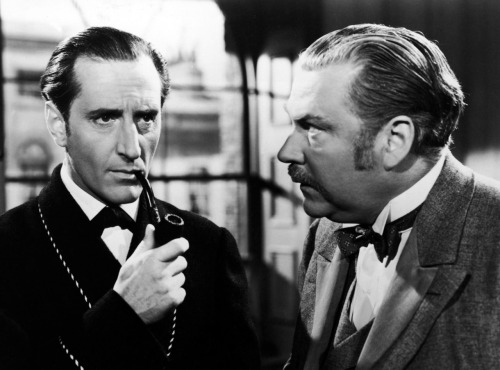
I did read the Sherlock Holmes books as a teenager and liked them (The Speckled Band and Blue Carbuncle were my favourites), but I never got on with the Rathbone and Bruce portrayals of the crime-fighting duo, which are probably the most well-known.  I think my problem was that I always found TV Watson to be a bit dense when in the books I really liked how astute he was.  Since the purpose of Watson is to be our viewpoint of the incomprehensibility of Holmes, we often see him not understanding clues or needing explanations, but he's not supposed to be dim-witted.  Yes he looks slow next to Holmes but everyone has that problem.  Watson's had a career in the army as a medical doctor so clearly he's very intelligent, resourceful, and physically fit, allowing for his war wound.  But for a long time the typecast for Watson has been a rather portly, jolly sort of fellow who is in a constant state of bedazzled awe.  He's not Holmes' colleague, he's his porter and fanboy.

What the BBC reboot Sherlock has done which I admire is that it's given the relationship a dynamic where Holmes' eccentricities from the books are played up and his intensely analytical mind comes at the price of his emotional awareness, as genius often can.  Even in the original stories when Holmes does show particular charm or concern towards others it's often an attempt to manipulate them into giving up clues for his latest case.  In the third TV episode of Season One, The Great Game, he comments on how caring about the world at large is a waste of time and energy, as it would compromise his ability to think properly, at which John is duly shocked.  Watson is in awe of his colleague's reasoning skills, but also in constant frustration at how insensitive he is to people's feelings.  Season One begins with Sherlock and John as Mad Genius and Awestruck Groupie respectively, but by this second season you see that a shift has taken place.  Previously they were flatmates.  Now they are friends.  John continues to be impressed by Sherlock but no longer gushes over his every exposition, will firmly chastise him when he goes too far, and navigates the human element for them both (manners, decorum, empathy) since that's the one area of life Holmes struggles to comprehend.  In turn Sherlock has become genuinely fond of his "blogger"; he accepts that his friend has qualities that he doesn't (he can aim a firearm for one thing), delegates to him on cases so that they work together rather than one merely spectating -although he still uses him shamelessly when the need arises-, and may even aquiesce with some good grace when John corrects his behaviour.  In the space of just one episode, 'Scandal in Belgravia', he says both "Please" and "Sorry", I think for the first time ever, as well as jumping to the defence of his landlady when his brother Mycroft insults her.  At Christmas they have visitors!  Actual visitors!  Who want to be there!

I wanted to subtitle that episode "In Which Sherlock Has Friends", or perhaps "In Which Sherlock Ceases To Be A Heartless Machine".  It's a nicer, more complex, and more balanced combination than Genius and Bumbler; Holmes' whirling mind and mad exploits give Watson's life a much needed kick, while Watson's loyalty and solid reliability keep Holmes from spiralling off into the blue unknown.

The rub now will be this; Sherlock has shown his Achilles Heel.  The combination of Holmes and Watson broadens them both as people, but also makes them increasingly susceptible to attack as they rely more on each other.  And now we have Jim Moriarty in the picture.  I'm more than a little concerned.